My British Heritage

As we live in an increasingly multicultural society, we have many different peoples of different cultures, ethnic and gene pool backgrounds and lots of interesting and delicious cuisines! Genuine multiculturalism is special in that it fosters an environment of inclusivity, social cohesion, breaks down tribalism, and can make for interesting conversations.
Most if not all of us in Australia and very likely in most other countries too have had interactions with different cultures and peoples, whether of East Asian, South Asian, South African, Central African, Latino, Southern European, Northern European, Irish, Scottish or English, Indigenous American, and Indigenous Australasian origins. There many, many others I have obviously not mentioned that are just as important to multiculturalism. We all bring something to the table where we share our stories, culture and food.
What do I bring to the table? Well, I bring a test and my ancient British origins. I went on to Ancient DNA Hub and saw ancient ancestry tests including Ancient Semitic Ancestry' test, Ancient North Amerindian Ancestry test, Ancient South Amerindian Ancestry' test and the 'Ancient British Isles Ancestry' test which revealed what can be seen in the following images.
These are localised gene pools and are subsets of both foundational gene pools found in another test from Ancient DNA Hub called 50 Gene Pools test which I recommend. It is kind of like zooming in to where your more localised ancestry lies as I am predominantly British in my ethnicity. Two of my Grandparents were born in Yorkshire, one grandparent was from Ireland and the other from Australia and had a mix of German, Cornish, Scottish and English. The DNA test is a bit like a hierarchical model, begin at the foundational gene pools like the 50 rare gene pools one, then go to the peak by taking a localised gene pool test like ancient British Isles Ancestry test. The British Isles Test has determined for me my real ancestry and my real ethnicity, which is spot on, I think.
The test can go back where our physical records cannot. See my affiliations page and check out the website from there.
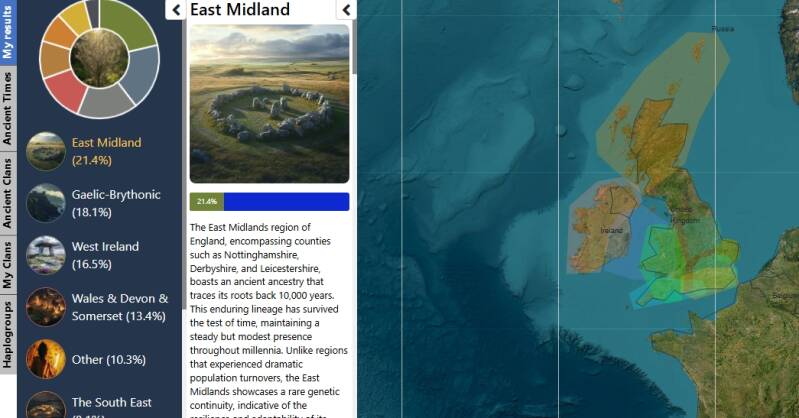
Have you wondered if you have ancient Brythonic in your ethnic make-up? When I took the Ancient British Isles Ancestry test, I found out I have ancient Brythonic in my ethnic make-up. This can be found in the Gaelic-Brythonic gene pool. You may also have other gene pools too including the following (note that most of the content in the ten points below are summarised with the help of AI from Ancient DNA Hub, the rest of the content is non-AI content).
1 East Midlands: A highly continuous Mesolithic-derived population remained stable in the East Midlands for thousands of years, preserving one of Britain’s more enduring inland genetic lineages. Later Neolithic farmers and Bronze Age groups mixed with this population without fully replacing it, creating a blend of ancient hunter-gatherer, Anatolian-farmer, and European Bronze Age ancestry.
2 Gaelic-Brythonic: The Gaelic-Brythonic gene pool emerged from a mixture of Atlantic Mesolithic hunter-gatherers, Neolithic farming peoples, and Bell Beaker Bronze Age migrants. This ancestry became strongly associated with Ireland and Wales, contributing to the foundations of later Celtic-speaking populations. The Gaelic-Brythonic gene pool is a hybrid gene pool meaning that if you have this gene pool, that means you have inherited both Brythonic and Gaelic ethnicity.
3 West Ireland: West Ireland retained unusually strong Neolithic farmer ancestry descended from Anatolian-Aegean migrants who spread agriculture across Europe. Although Bell Beaker and Atlantic Bronze Age influences were added later, the region preserved a high degree of ancient Neolithic continuity.
4 Wales & Devon & Somerset: This gene pool combined Ice Age-descended western hunter-gatherers linked to eastern Europe (Ukraine) with later Neolithic and Bell Beaker migrations. The result was a durable Atlantic-Celtic population shaped by both prehistoric continuity and Bronze Age European admixture. Wales, Devon and Somerset are the regions within which this gene pool appears.
5 South East England: South East England preserved one of Britain’s oldest continuous ancestral layers, rooted in Mesolithic hunter-gatherer populations. Continental European Neolithic and Bell Beaker migrations heavily influenced the region, but these newcomers blended with rather than erased the earlier population.
6 South Central-East England: This region preserved a rare ancestry connected to Northern Eurasian and steppe-related populations associated with early Indo-European expansions. Neolithic farmers and Beaker migrants later merged with these earlier inhabitants, producing a genetically distinctive but mixed south-central British population.
7 South England: South England’s ancestry contains deep roots connected to ancient eastern European and North Eurasian hunter-gatherers who migrated west after the Ice Age. Later Neolithic farming and Bronze Age Beaker migrations created a genetically layered population while preserving strong continuity from earlier inhabitants.
8 East Anglia: East Anglia developed from long-standing Mesolithic populations that later absorbed Neolithic farmer ancestry from Anatolian-Aegean migrants. Bell Beaker migrations from western and central Europe reshaped the gene pool further while maintaining strong regional continuity.
9 Scotland: Scotland’s ancient population formed through the blending of Mesolithic hunter-gatherers with Neolithic farming groups ultimately descended from the Fertile Crescent and Levant. Bronze Age Beaker migrations and later Celtic populations added substantial central European and Indo-European ancestry over time.
10. Other: The other refers to how much Non-British Isles you may have or how much DNA you have that does not fit into any of the gene pools. My 'other' came out as 10.3% which is spot on once again because I have German ancestry too for example.
You should be able to see my results which include most of these gene pools in my DNA. The gene pools have a side bar which can be read describing the history, context and genetic influences of the people and the regions of the gene pools in more detail.

After you have seen your results, you can also find out in the 'Ancient times' section which genetic profiles in historical localities you have with your genetic profile. Your similarity with that of historical groups or individuals in localities can extend from highest to lowest. Matches have either one locality or various ones which are averaged.
Individuals and groups in localities can range from different eras such as Neolithic times, Bronze age, Iron age, and the Medieval era, and different regions in Scotland, Ireland, Isle of Man, England and Wales. There may be multiple localities which you can click on with possibly differing percentages. You can also see their haplogroups too.
As can be seen in the image, my profile is closest to the Shetlands Iron Age match. You can also compare your ancestry breakdown with that of your matches.
A high match above 50% would mean that you would have a direct ancestry relationship with a close relative of the individual or group in locality such as a parent or sibling. 100% similarity would indicate an identical twin profile. A percentage higher than 10% is significant and considered very high. It is the 'culture' result for the Ancient British Isles Ancestry Test.

In 'Ancient Clans' section you can also see the genetic relations between British Isles Clans and look at their eras in an interactive display with dates (e.g. 720 AD). This is visible in the images next to the text.

In the 'My Clans' section it mentioned my clan match as 'England, East Riding of Yorkshire, Pocklington (Burnby Lane)' which is spot on as a big chunk of my heritage is from Yorkshire. What clan will you be matched with? It also talks about your neighbouring clans too which are interesting to see and the bands in clan (a small group of closely related people in a clan).


In the 'haplogroups' section, there is also a map to see where your mtDNA (direct lineage from mother's side through an all-female) and Y Haplogroups (direct lineage from father's side through an all-male lineage) are from too.
In the image you see, you can also use the slide bar to filter the eras (e.g.1001 CE - 1504 CE) in which you can find your haplogroups and mtDNA as can be seen in the example in the second of the two images next to the text. You can also search your own haplogroup and mtDNA in a small text box above the map which will display your own or perhaps a historical individual's or group's mtDNA or haplogroup on the map at a particular era. You can adjust the eras and haplogroup letters and numbers to find out where your ancestors in Britain originated on the map. I recommend you check this out also as Dr. Elhaik has put a lot of time and effort into developing this.
Create Your Own Website With Webador